
Guide
What a Service Call Actually Covers in Sedona
Sedona's homes mostly date to 1985-1991, sitting in a cold-moderate climate band. Here's what a real service call checks on that specific stock, room by room.
Local detail
What Local Conditions Do
Most of the houses we work on across Sedona's service area went up between 1985 and 1991, with a median build year of 1987. That's not a random detail - it means the torsion springs, the drums, and in a lot of cases the original opener are pushing thirty-five to forty years old. Steel fatigues on a schedule, and a spring wound in 1987 doesn't care how well the door looks today.
Sedona sits in a cold-moderate climate band, which is milder than a true northern winter but still cold enough at night to matter. Steel contracts, grease thickens, and the torsion spring loses a little tension every time the temperature drops hard overnight and climbs again by afternoon. On a door that age, that daily swing is doing real work on hardware that's already near the end of its rated cycle count.
A service call on a house like this isn't a generic tune-up. It's checking spring wind against the door's actual weight, looking at drum set screws that may never have been re-torqued, and checking whether the opener's force settings still match a door that's sagged or shifted slightly over three and a half decades. None of that shows up if you're just oiling hinges.
The area
Checking It Yourself
Before you call anyone, there are a few things you can check in five minutes. Disconnect the opener and lift the door by hand halfway - it should hold there on its own. If it drops or shoots up, the spring tension is off, and on a door built in the late 1980s that's often the original spring finally giving out rather than a fresh problem.
Listen while it runs. A grinding or popping sound usually means a roller or a bearing plate that's worn past its lubrication point, common on hardware this age that's never been replaced. Look at the weatherstripping along the bottom and sides - in a cold-moderate climate, brittle or cracked seal lets in enough cold air overnight to matter for anything stored in the garage.
Check the photo-eye sensors near the floor track. Dust or a slight knock out of alignment is the single most common reason an opener refuses to close, and it costs nothing to clean and re-aim them yourself.
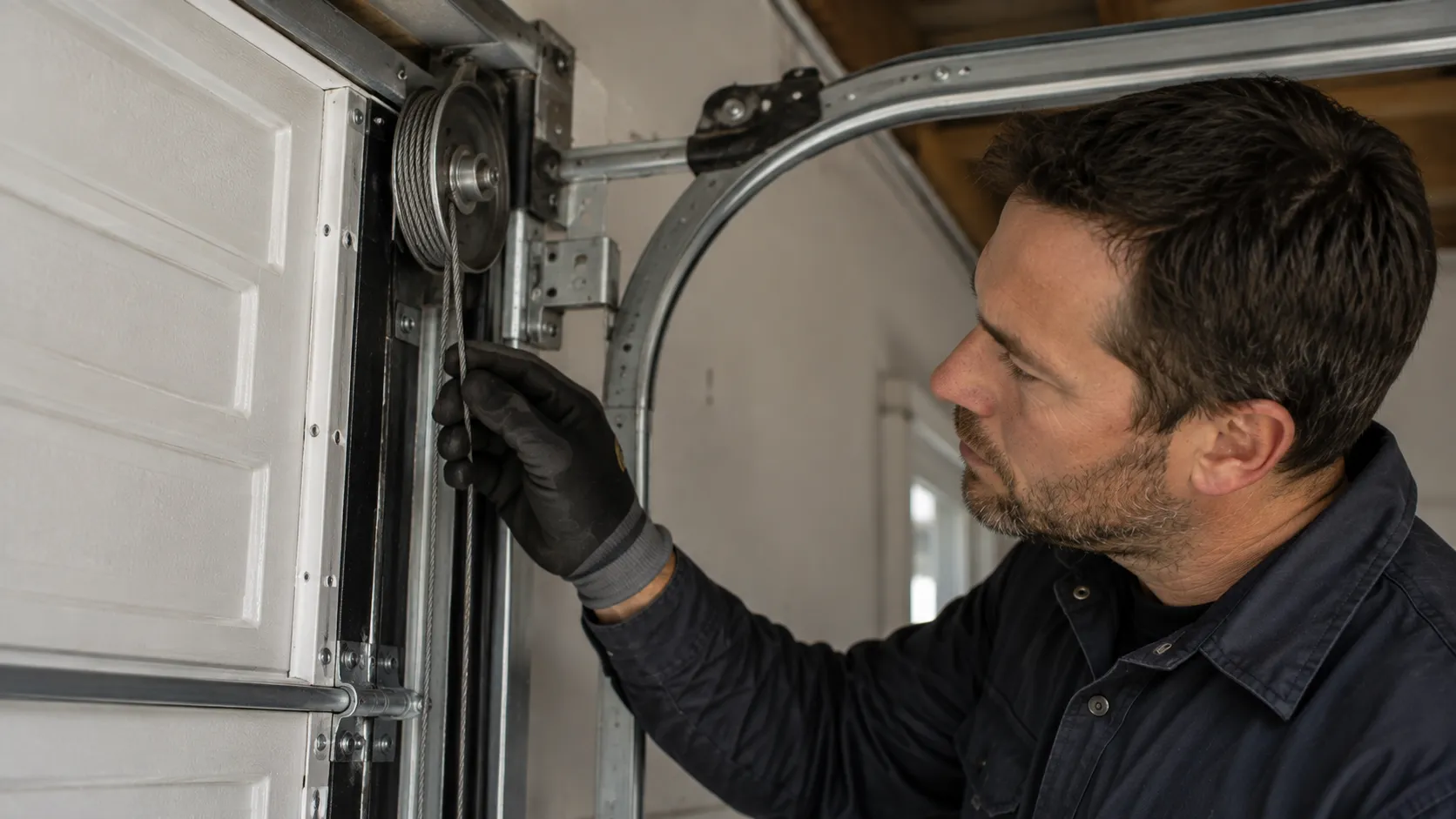
What you shouldn't touch: the torsion spring itself. It's wound under enough tension to cause a serious injury, and on a door from this era the winding cones are often original and more brittle than they look.
What we find
The Situation
The service area runs about 8,775 households, with roughly 7,259 of those owner-occupied houses - and the bulk of that housing shares the same 1980s-to-early-90s build window, spread across six named areas rather than one subdivision. That matters for parts: a lot of these doors use hardware sizes and opener mounts that newer big-box replacements don't match without adjustment.
Median household income in the area sits at $70,925, and what we see on calls reflects that - owners weighing a repair against replacement rather than automatically pushing another part into a thirty-five-year-old system.
We cover the town itself along with the surrounding stretch: Chapel is about 2 miles SSE and often the fastest add-on to a Sedona call, while Cornville (10 miles), Munds Park (11 miles), Lake Montezuma (15 miles), Clarkdale (17 miles), Kachina Village (17 miles), and Mountainaire (18 miles) round out the routes we run. Distance changes how quickly we can get to a job, not what we check once we're there - the hardware age is the same problem no matter which of those roads we drove in on.
How we work
What Changes With the Season
In a cold-moderate band like this one, the biggest seasonal shift isn't a single hard freeze - it's the daily swing between a cold night and a much warmer afternoon. That cycle is harder on aging hardware than steady cold would be, because the steel and the grease inside the spring never settle at one temperature long enough to stay predictable.
On a door built in the late 1980s, that shows up as tension that reads differently morning versus afternoon, openers that strain more on the first cold run of the day, and rollers that squeal until they warm up. None of this is dramatic, but on hardware already past its expected cycle life it adds up faster than on a newer door.
We don't carry every obsolete part for openers from that era - some of the older chain-drive units used mounts and gear kits that simply aren't made anymore, and at that point patching one part is a short-term fix. If the opener or springs are original to a house built in that 1985-1991 window, a straight repair sometimes costs more over a year than replacing the unit once and being done with it. That's a call we'll make with you on-site, not before.
Questions
Common questions
How old is a typical garage door system in Sedona?
Most houses in the service area were built between 1985 and 1991, median year 1987. That puts a lot of original torsion springs and openers at thirty-five to forty years old, well past the point where a repair should be assumed to be the cheaper option.
Does Sedona's climate actually affect garage door hardware?
Yes. The area sits in a cold-moderate band, and the daily swing between a cold night and a warmer afternoon stresses spring steel and thickens grease more than steady cold would. On older hardware that shows up as inconsistent tension and a stiffer first run of the day.
Do you cover areas outside Sedona itself?
We run calls out to Chapel (about 2 miles), Cornville (10 miles), Munds Park (11 miles), Lake Montezuma (15 miles), Clarkdale (17 miles), Kachina Village (17 miles), and Mountainaire (18 miles), alongside Sedona proper.
Is it ever better to replace than repair?
Sometimes. If the door is original to a house from that 1985-1991 build window and the opener uses parts that aren't made anymore, another repair can cost more over a year than replacing the unit once. We'll tell you straight when that's the case rather than stack another part onto it.
Ready when you are
Need a garage door sorted in Sedona?
Sedona Garage Door Pros repairs and installs garage doors, springs and openers in Sedona, AZ and the surrounding area.